Showing posts with label Freud. Show all posts

Friday, 21 October 2011

Seminar Paper - Freud

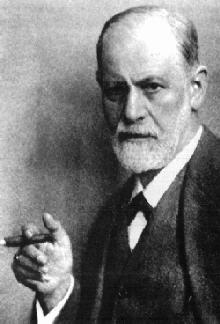
Sigmund Freud was born on May 6th 1856 to a Jewish family in the town of Moravian in the Czech Republic. He was a neurologist and is best known for his theories of the unconscious mind and repression.
Freud lived in a repressed time after the age of Enlightenment which taught an empirical view of everything in the universe. Freud’s theories challenged this rationality as he believed it was impossible for the human mind to understand the complexities of the universe. At the centre of all of Freud’s theories was a dark vision of humanity and pessimism.
Like Plato, Freud believed in the idea of the tripartite self, but differed to Plato in the sense that he believed that the rational part of our personalities were not the dominant force. Instead Freud believed that the dominant part of our personalities is the ID which is our basic instincts and desires; or as Freud called it the ‘cauldron of seething expectations.’ Freud claimed that the ID is present from birth and should be repressed at all costs because it reveals our deepest desires to cause pain to others and ultimately seek our own destruction. The ID is the subconscious part of our mind which we have no control or awareness of.
Alongside the ID, the other two parts of the personality, according to Freud, are the Ego and the Superego. The Ego represents the conscious part of our mind and is the reality principle. Freud believed this was the least powerful part of our personality and it is in constant battle with the ID. The Ego is our common sense and reason that we are aware of and able to control.
The Superego is the morality principle, the internalised rules imposed on us through socialisation. The Superego imposes impossible standards of perfection and then punishes us with guilt when we do not reach the internal ideal. It is in constant battle with the ID because the ID drives us to behave in ways that go against the rules of society, for example causing harm to others.
Freud was adamant that the ID needs to be repressed at all costs and that the Ego needed to be strengthened. He claimed that the only way to achieve this was through psychoanalysis, although he accepted that this was not an option available to everyone. Because of this, Freud suggested three coping mechanisms; intoxication, isolation and sublimation. He stated that these coping mechanisms only provided temporary satisfaction to the ID, but that the IID would always want total satisfaction. Freud warned that if the ID was given total satisfaction then it would lead individuals to behave in incredibly destructive ways.
Freud’s belief that the ID, our subconscious, is the dominant force in our lives is one which leads to questions of free will and determinism. If we are all driven to behave in certain ways by our subconscious mind, do we actually have free will over our actions?
In 1924 a lawyer called Clarence Darrow used the idea of the subconscious as a defence for murder. He was defending Richard Loeb and Nathan Leopold, aged 18 and 19, who pleaded guilty to the murder of 14 year old Bobby Franks.
Darrow believed Freud’s theory that psychological influences control human behaviour and argued that murdering Bobby Franks was not a conscious decision between right and wrong by Leopold and Loeb
Leopold himself stated that:
“The thing that prompted me to do this was a sort of pure love of excitement…a love of thrills…the satisfaction of the ego...”
If you look at the case of Leopold and Loeb from a Freudian point of view, it could be argued that they murdered Bobby Franks because their IDs had not been repressed and had overridden their ego and superego’s; which did in fact lead to destructive and dangerous behaviour. Darrow’s defence that the boys did not consciously choose between right and right and were not acting according to their own free will was successful and Leopold and Loeb were sentenced to life imprisonment instead of the death penalty.
I think that the idea that we do not have free will over our actions and that we are somehow being controlled by our subconscious mind is fascinating, and it has been the subject of many psychological and empirical experiments.
A criticism of Freud’s theory of the subconscious mind is that there is no way to prove the existence of the subconscious mind; and certainly no way of proving that the subconscious mind is able to overpower our conscious minds. However, in the 1970s a researcher in the physiology department of the University of California called Benjamin Libet conducted an experiment which could be used to prove Freud’s beliefs of the subconscious mind.
Libet monitored the electrical processes in the brain while asking the patient to perform simple tasks such as raising their arm. His results proved that subconscious electrical processes in the brain preceded the patient’s conscious decisions to perform spontaneous acts. On average, Libet found that the subconscious mind started the process of raising the arm 0.7 seconds before the patient’s conscious mind started to react.
It could be argued that these findings prove that the subconscious mind is able to control our actions over our conscious minds, or in Freudian terms, the ID is able to overrule the Ego and the Superego. Freud believed that the ID was only able to truly take control of our thoughts when we are asleep, because he claimed that when the physical body is asleep, the Ego is also asleep, allowing the ID to be expressed.
Freud believed that our dreams are the pathway to understanding the desires of the ID, and only through the interpretation and analysis of dreams are we truly able to understand what our repressed wishes. In Philosophy in the Modern World, Anthony Kenny explains that we are unable to interpret our own dreams because they are coded. These codes are unique to each dreamer and Freud believed that, when stripped down, all codes are usually repressed sexual desires. Kenny argued that in order for Freud’s theory of dreams to be accurate, the interpretation must be accepted by the dreamer, although in many cases the dreamer does not accept them. Freud would argue that the dreamer does not accept the interpretation because their conscious mind tries to repress their subconscious desires, so much so that they are unable to accept them.
The interpretation of dreams is something that has become mainstream in today’s society, with websites and magazine features dedicated entirely to helping you understand what your dreams mean. Some examples of this is that if you dream about travelling this is symbolic of the journey of life and if you dream about being in a car crash it means that you are worrying that you are  not in control of everything in your life.
As well as our subconscious being revealed through our dreams, Freud also believed that there are two more sets of phenomena that reveal the existence of the unconscious. The first of these are trivial, everyday mistakes which he called ‘parapraxes’ and we now refer to as ‘Freudian Slips’. Freud used the example of a professor who in his inaugural lecture instead of saying ‘I have no intention of underrating the achievements of my illustrious predecessor’ actually said ‘I have every intention of underrating the achievements of my illustrious predecessor.’ Freud claimed that parapraxes such as this one reveal hidden motives of the subconscious.
The second way in which Freud believed the existence of the subconscious is revealed is through neurotic symptoms that can only be interpreted by a psychiatrist, although this is only successful if the patient accepts the interpretation.
Ultimately I feel that there is still a place for Freud’s theories of the subconscious mind in today’s society, particularly the significance of the interpretation of dreams.

Sunday, 16 October 2011

Philosophy in the Modern World - Chapter 8 synopsis

The reading for HCJ this week is chapter 8 from Anthony Kenny's book Philosophy in the Modern World. The following is a synopsis of the key points in the chapter in preparation for my seminar paper this week.

Bentham on Intention and Motive:
  • Bentham explored the effect of moral character depending on the presence or absence of different cognitive and affective elements.
  • His approach reflects Aquinas' but he differs in terminology and moral evaluation.
  • Aquinas believed that an act is intentional if it chosen as a means to an end. If an action is an unavoidable consequence or accompaniment to such a choice it was not intentional but only voluntary.
  • Bentham argued that 'voluntary' was the wrong word for Aquinas to use and he should have used 'intentional'.
  • Bentham believed in the same distinctions as Aquinas, but said that they were distinctions of intention.
  • A consequence is either directionally intentional or obliquely intentional.
  • A directly intentional action is either ultimately or immediately intentional depending on whether the action was a motive or not.
  • Bentham wanted to define intention in cognitive terms
  • He believed that intention is a key criteria for moral and legal evaluations of actions.
  • Intentions are not good or bad in themselves, the consequences make them good or bad.
  • Consequences are dependent on circumstances, and circumstances are either known or unknown by the agent.
  • If the circumstances are known by the agent an act is an advised act. An unadvised act is when the circumstances are not known by the agent.
Reason, Understanding and Will:
  • Both humans and animals have a sense of understanding and sensation.
  • Only humans have the ability to reason and a capacity for reflection which allows us to have language, freedom and science.
  • Abstract knowledge can be retained and shared.
Schopenhauer:
  • Both humans and animals have wills but only humans can deliberate.
  • Ethics is based on morals but morals are abstract
  • Will is present and active in the universe.
  • All will rises from a want, which implies a deficiency in something and therefore all will comes from suffering
  • The definition of a genius is someone who is 'imaginative and restless...dislikes mathematic and lives on the borderline of madness.'
  • Rejects the idea of the dualism of mind and body
  • 'The body is nothing more than the objectification of the will and its desires.'
Experimental Vs Philosophical Psychology:
  • The science of the mind was introduced in the 19th century though empirical and experimental methods.
  • Professor of psychology, Wilhelm Wundt introduced the science of the mind in 1879 in Leipzig.
  • In 1878 William James set up a psychology lab in Harvard University - the first doctorate was awarded.
William James:
  • Wrote Principles of Psychology in 1980 - a summary of new findings in psychology.
  • Theory of emotions - proposed emotions are perceptions of bodily processes; all states of consciousness can be called 'feelings'.
  • Some feelings are cognitive and some are not.
  • For a feeling to be cognitive there must be in the world another entity resembling the feeling in its quality and the feeling must be directly or indirectly operate upon this entity.
  • Consciousness is essentially a private, internal phenomenon, capable of existing in isolation from any body.
The Freudian Unconscious:
  • In his book Introductory Lecture of Psychoanalysis, Freud stated that the greater part of our mental life is unconscious.
  • Only a fraction of what we know and believe is present to consciousness in the sense of being an object of our immediate attention.
  • Freud believed that there are three sets of phenomena that reveal the existence of the unconscious:
  1. Trivial everyday mistakes: Freud suggests that these mistakes are not accidental, they reveal the hidden motives of the unconscious
  2. Reports of dreams: Freud called dreams 'the royal road to a knowledge of the unconscious activities of the mind' but we cannot interpret our own dreams, we need a psychoanalyst. He believed that dreams are our repressed wishes and are coded, but when stripped down they are usually sexual. Dream codes are unique to each dreamer, they cannot be universalised.
  3. Neurotic symptoms: The interpretation of neuroses by a psychoanalyst is dependant on the patient accepting the interpretations, but often patients do not accept this.
  • Freud explained that mental harmony is dependant on the conflict between the ID, Ego and Superego.
Philosophical Psychology in the Tractatus:

  • Tractatus Logico-Philosophicus was written by Ludwig Wittgenstein.
  • Wittgenstein tried to explain the model of the mind.
  • He accepted that psychology is genuine empirical science and thought that philosophy of the mind was on a par with psychology.
  • In Tractatus he states that a thought is a logical picture of facts.
  • Wittgenstein identified thoughts with propositions which could be either a sign/sentence or a thought. A sign or sentence is a relation between spoken words. A though is a relation between physical elements.
  • Thinking a thought involved a psychic element in the sense of mental images or internal impressions.
  • Meaning is conferred on signs by us and our conventions - these are not facts of science.
Intentionality:
  • Brentano reintroduced intentionality into philosophy in the 19th century.
  • In his book Psychology from an Empirical Standpoint (1874) Brentano wanted to marl off physical from physical phenomena.
  • He claimed that there are two kinds of action:
  1. Transient: Actions that change their object
  2. Immanent: Actions that change the agent not the object
  • Brentano's distinction between physical and physical phenomena corresponds to the distinction between immanent and transient actions.
  • Husserl took this over from Brentano.
  • Husserl tells us that consciousness consists of 'intentional experiences or acts'.
  • Every mental acts is a certain kind belonging to a certain species.
  • He called individual acts the noesis and the specific content the noema.
  • Acts have matter and qualities - so do imaginations, perception, emotion and volition. For example, seeing Rome and imagining Rome have the same content (Rome) but different qualities (imagining and seeing).
Wittengstein's Later Philosophy of Mind:
  • Wittengstein's later philosophy was a direct reaction to Bertrand Russell, who ignored intentionality.
  • Wittgenstein believed that intentionality was all important in understanding and language.
  • He thought that the human mind is not a spirit and that there is not such thing as the self.
  • Thought and understanding are not processes - there are different criteria of 'thought' and 'understanding'
  • He demolished the concept that the connection between consciousness and expression is merely contingent - if this was true then theoretically everything in the universe could be conscious.
  • The only evidence that humans are conscious is that we all consciousness in ourselves.
  • Experiences one can have is dependent on how one can behave.
  • It is wrong to identify the mind with behaviour - it is even more wrong to identify the mind with the brain.
  • Connection between mind and brain is contingent, discoverable by empirical science.

HCJ Lecture 2 Notes - Sigmund Freud

This week I am writing the seminar paper about Freud so I will post these notes from the lecture Brian gave about Freud before posting my seminar paper later in the week.

Overview of Freud:
  • Born in Vienna 1856.
  • Died in London 1939.
  • Deeply ambitious.
  • Psychoanalyst - tried to explain everything.
  • Controversial/Subject to criticism.
  • Lived in repressed times - his ideas challenged this and challenged the ideas of the Enlightenment - alternative to rationality.
  • Believed we cannot understand the universe, it is impossible.
  • The centre of Freud's thoughts was pessimism.
  • His theories are a dark vision of humanity.
Attack on Plato:
  • He followed Plato's ideas of the tripartite self: Reason, Spirit and Desire.
  • He disagreed with Plato's belief that Reason can overrule the other two.
  • Freud believed that Reason is the weakest part of a person because people are irrational.
Attack on Marx
  • Marx also believed in the idea of a tripartite self: Natural, Species and Alienated.
  • Marx believed in the teleological development of humanity; that we are all moving towards something, which he believed to be Communism. 
  • Freud thought this was too idealistic because deep down we are all aggressive and that is the basic level that drives us on. He thought we are fundamentally limited so can never develop.
  • Ultimately our desire is to hurt people and eventually seek our own destruction.
  • Marx believed that is we change the systems in out society then things will get better. Freud disputed this claiming that people are the system - we create a system that is ultimately bad for each other because deep down we enjoy to see others suffer.
Freud had the confidence to dismiss Plato and Marx because he believed he discovered psychoanalysis.

The Freudian Personality:

Freud believed that the human personality consists of three parts:
  1. ID: This is the animal part of our personality, our basic desires and instincts, or as Freud described it; 'a cauldron of seething expectations'. The ID is a reservoir of our unconscious present from birth. This is the dominant personality.
  2. Ego: This is the reality principle, our conscious self, our reason and common sense. This is the weakest of the three personalities. The Ego is constantly battling with the ID. 
  3. Superego: This is the morality principle, the socialised part of our personality, the internalised rules from our parents, society, etc. This sets an impossible standard of perfection and then punishes us with guilt when we do not reach expectations. The Superego is also in constant battle with the ID. Freud believed that civilisation is a collective superego imposing moral limits on the ID.
Freud believed that everything in live is pain, classifiable in these three ways:
  1. Our own decaying bodies and eventual death
  2. The things which happen to us throughout life
  3. Interaction with other people - Freud believed this was the worst pain of all
Freud thought that the solution to dealing with all the pain in life is through analysis to control the ID and make the Ego stronger. Although he accepted that psychoanalysis is not an option available to everyone, so also suggested temporary coping mechanism for those who could not have psychoanalysis.

Coping Mechanisms:
  1. Intoxication
  2. Isolation
  3. Sublimation
These coping mechanisms will only give temporary, mild satisfaction because the ID wants total satisfaction.

Freud said that the key to understanding and controlling the ID is through the interpretation of dreams and hypnosis. He explained that when we are asleep the Ego, our conscious self, also sleeps, so that the ID is able to run free through our dreams revealing our true desires.

Criticisms of Freud:
  • Freud did not discover or prove the existence of the unconscious he only made it mainstream. Many before him discussed the idea of the unconscious self. for example Shopenhauer believed man was irrational, guided by internal forces of which he is not aware.
  • Falsifiability - there is no way to validate Freud's theory of psychoanalysis. For example, if Freud was to say to someone "you had that dream because you hate your mother" there is no way for the dreamer to validate that Freud has revealed a repressed desire.
Reich:

Reich was a disciple of Freud but ultimately disagreed with parts of Freud's theory. For example, Reich believed that the unconscious forces in the mind are good that it is their suppression by society that makes them dangerous. This differs to Freud who believed that the unconscious is dangerous and should be suppressed by the individual at all costs.

Reich believed in a tripartite self, but differed to Freud in what the personalities are:
  • Polite personality - Surface Layer
  • Cruel personality - Second Layer
  • Honest/Loving personality - Core
Followers of Reich are encouraged to express feelings openly which is the opposite to Freud who taught people to repress everything.