The initial reason for writing this column was because of the conversation that I had overheard between two university students, one who claimed that Tuna was Dolphin meat. At the time I thought it was hilarious and could not believe that the comment had come from someone studying for a degree, when it is believed, for the most part, that university students are highly intelligent.
I was unsure about what angle I wanted to use in this column. Initially I wrote a column about how society happily ridicules the unintelligent in all aspects of life, and I looked into reasons why this might be. I decided that this was similar to the column I wrote last semester entitled "the awkward moment when...", in which I discussed the reasons that people ridicule each other and themselves on facebook.
I then started to think about what kind of people would find the boy's comment most funny. I thought that other university students would find it quite funny, but may well have heard comments similar to that frequently at university. I eventually came to the conclusion that the people who would be most likely to find it funny would be people who did not go to university themselves because they are continually under the impression that university students are highly intelligent.
I then began to think about the fact that it might be a relief for someone who didn't go to university to find that even students come out with unintelligent comments. This is because we live in a society where the belief is that the higher educated a person is, the more intelligent they are.
I then thought back to how I felt when I thought that I may not be able to finish my degree, and how pressure from society made me think that I would be thought of as unintelligent or a failure if I didn't have a degree. It was then that I decided to write this column as somewhat of a reassurance that having a degree is not the be all and end all, and that ultimately when you pass people in the street you can't tell who has one or not - and I highly doubt that anyone even cares.
This column was very personal and I tried to explain exactly how I felt whilst I was absent from university, and how I dealt with accepting the fact that I might not be able to get a degree. I hoped that by including such personal details, readers may take my thoughts more seriously. I also hoped that the column might be almost a guide to anyone struggling with their degree, or thinking of dropping out, and reassurance to someone without a degree that it is not the most important thing in the world.
I named the column 'to degree or not to degree?' to mimic the famous like from Shakespeare's Hamlet - 'to be or not to be?' In Hamlet, the character of Hamlet questions 'to be or not to be?' in reference to life and whether to commit suicide or not. (Although this is only one of many interpretations.) I chose to mimic this is my title somewhat ironically, to try and make the point that having a degree or not is not a matter of life and death. I also thought that it would be an effective title because 'be' and 'degree' rhyme, so it would not be difficult for the reader to pick up on the reference to Hamlet.
I made the dceision to include five 'ephianies', or rather conclusions that I had come to when I realised that I might have to accept not having a degree, because of the positive feedback I had about the 10 life lessons I gave in my column last semester: "would you rather?". Due to the success of those lessons, I thought that giving five more would hopefully result in the same positive feedback from my readers.
With the exception of my column last semester, 'meeting with a medium', this column has been one in which I have been truly honest about revealing personal aspects of my life. I feel that this is something that the readers will be able to relate to and hopefully respond well to. I am happy with how this column turned out.
Showing posts with label Critical Reflection. Show all posts
Showing posts with label Critical Reflection. Show all posts
Wednesday, 14 March 2012

Tuesday, 13 March 2012
Critical Reflection: Missing Mother
I decided to write a column about mothers this week because Sunday is Mothers Day, and so it would be relevant and in the minds of my readers. I also decided to include the fact that Mothers Day falls on my 20th birthday as a way of linking my separation from her to the fact that I am maturing and yet still have difficulties being completely independent.
I thought about what in particular I wanted to write about mothers, and decided that it would not be interesting to simply read about how I feel about my own, and instead wanted to write about something that the reader would be able to relate to. The majority of people who look at the features on http://www.winol.co.uk/ are students at the University of Winchester, so I needed to make sure that I wrote about something that they in particular would be able to relate to. That is why I made the decision to write about how I have found becoming independent at university and moving away from my mother for the first time, as many other students at the university have had to do the same thing.
I decided to focus on the task of laundry because during my time here this seems to be the recurring chore that students find difficult. I also hoped that I would be able to make the column humorous by including examples of other students' attempts at laundry that I have experienced and that I found to be funny at the time.
Although I had a target audience in mind, I also tried to include things which people who are not students would be able to relate to, and hoped that I wrote the column in such a way that the examples would be funny even if the reader has never been in that situation themselves.
I have to admit that with this piece, with the exception of the title, I did not focus as much on literary devices. This was because I wanted to share my own experiences honestly, without being sidetracked by trying to make it more interesting or relatable than it was in reality. I felt that the only way for the piece to sound as honest as I wanted it to was to write completely honestly! And so, in terms of critical reflection there is actually not much to analyse!
I am extremely pleased with the finished column and hope that I succeeded in making it both humorous and relatable.
I thought about what in particular I wanted to write about mothers, and decided that it would not be interesting to simply read about how I feel about my own, and instead wanted to write about something that the reader would be able to relate to. The majority of people who look at the features on http://www.winol.co.uk/ are students at the University of Winchester, so I needed to make sure that I wrote about something that they in particular would be able to relate to. That is why I made the decision to write about how I have found becoming independent at university and moving away from my mother for the first time, as many other students at the university have had to do the same thing.
I decided to focus on the task of laundry because during my time here this seems to be the recurring chore that students find difficult. I also hoped that I would be able to make the column humorous by including examples of other students' attempts at laundry that I have experienced and that I found to be funny at the time.
Although I had a target audience in mind, I also tried to include things which people who are not students would be able to relate to, and hoped that I wrote the column in such a way that the examples would be funny even if the reader has never been in that situation themselves.
I have to admit that with this piece, with the exception of the title, I did not focus as much on literary devices. This was because I wanted to share my own experiences honestly, without being sidetracked by trying to make it more interesting or relatable than it was in reality. I felt that the only way for the piece to sound as honest as I wanted it to was to write completely honestly! And so, in terms of critical reflection there is actually not much to analyse!
I am extremely pleased with the finished column and hope that I succeeded in making it both humorous and relatable.
Monday, 12 March 2012
WINOL Critical Reflection - 07/03/12
Headlines: The headlines in this bulletin would not as strong as the previous week. There was a good quote of "there will be riots", but other than that there was little that was interesting enough to engage the viewer straight away. I thought that the script 'goals galore' was not particularly appropriate for news headlines, although this kind of script has been used frequently in the headlines this semester so perhaps it is a hit with viewers.
George Beckett: I thought that the story of George Beckett resigning was one that was relevant to the viewers, and particularly relevant as he has been interviewed so many times by WINOL. However, I did not think that any of the archive footage made sense in the context of what Flick was saying. For example when she was talking about Beckett, we could see a man's hand doing some paperwork, and whilst most people would use their common sense to assume that the man in the footage is Beckett, I feel that it would have been better if he had been clearly identified in the shot. Then when Flick was naming the other members who might take over the role, we again saw unidentified images of Beckett. This was confusing as the viewer would probably have expected to see footage of the people Flick was talking about. I think that the piece would have been better if the second archive footage of Beckett had been used in place of the first, with a strap line identifying him.
Strikes: This was an interesting story, and again was particularly relevant as the strikes were covered in great detail last year on WINOL. I thought that the use of archive footage worked well in this package. Louis was seen walking and talking with Steve Brine before the interview, which has become a frequent sight on WINOL and I feel looks really professional. The interviews with Brine and Ian Woodland were both relevant, well framed and ensured that Louis' piece was balanced. I thought that Louis' piece to camera this week was very strong.
Gay Marriage: I thought that this was a fairly strong piece, although the interview with the homosexual couple could have been framed tighter. I also though that George's piece to camera could have been tighter as well, although I appreciate that he was probably trying to make sure that the cross was in the shot. I think that George did quite well to give both sides of the argument, and thought it was good that he had asked someone else to do the voice over for the statement instead of doing it himself, which would have been less professional.
Air Traffic Control Course: This was a relevant story because it was about the University of Winchester, and the largest audience that WINOL has are students at the university here. This was quite a difficult story as there are not many shots that would have been relevant. I thought it was a good ideal to film at the airport, although there may be some problems with the fact that only Flybe planes were shown. There were some technical problems with the sound in the interview with Prof. Neil Marriott which should have been corrected or the interview left out entirely as it was impossible to hear most of what he had said.
Sport: It is no surprise that once again I have no criticisms of the sport!
And finally: The 'and finally' piece this week was not as strong as previous weeks, although this is understandable as it can't be easy to find a story as interesting as a giraffe being born every week! I thought that the piece was interesting and relevant to a younger audience. The interview with Mike Carroll was well framed, and although he was clearly excited and speaking informally, this is not too much of a problem with an 'and finally' piece. I thought the sign off of Hetty helping Carroll with the mixing was humorous and fit well with the piece.
Overall I think that the bulletin this week was not as strong as in previous weeks, but still very good work for university students.
WINOL Critical Reflection - 29/02/12
Headlines: There were some brilliant quotes in the headlines of this bulletin, including "catastrophic", "bubble will burst" and "so many I don't know where to start". The only criticism I have of the headlines was the line "Dancing on thin ice", which I thought was a bit cheesy for the headlines!
Sheep: I thought that it was very professional that Tom warned that some viewers might find the package upsetting. This package was good, with relevant shots. Hetty's piece to camera was very good and the interview with Graham Boyt was well framed and relevant. It was also good that Boyt only gave comment, not facts. The only criticism I have of this piece is that the voice over needed to be louder.
Budget Cuts: Louis' voice over and initial piece to camera were too quiet and I thought it would have been better if he had talked slower. However, it was good how he walked towards the camera during his piece to camera. The archive footage used in this piece was poor quality and perhaps should not have been used, although I can appreciate this might have been all there was to use. The interview with Brian Dash was well framed but had a couple of jumps in it.
Tap Water: I thought that Dan did well to find so many shots for this piece, and I particularly liked the closing shot of water going down the sink. Dan also made sure than his GV shots were all section 8 safe. I liked how Dan was seen walking and talking with Arshad Sharif before the interview. The interview was well framed and Dan got a good quote from Sharif.
University Courses: I thought that this was another good piece from Flick, and was pleased to see that she had a notebook in her hand and made use of it throughout her piece to camera. I thought that the graphic of the pie chart was confusing and somewhat unnecessary. The interview with Nick Rowe was well framed, although the cut away to him doing work during the interview was confusing.
Assault: I thought that this was a huge improvement from George's court piece in the previous bulletin. His piece to camera was brilliant and he made good use of his notebook when giving quotes. The reconstruction was very well done and meant that the piece was a good one for the bulletin, unlike his story in the previous bulletin which would have been better as a written piece only. I think that reconstructions are something that should be used on WINOL in the future because it was much more interesting to watch in comparison to only seeing a presenter doing a piece to camera.
Sport: Needless to say, sport was once again very strong and professional.
And finally: I thought that the 'and finally' piece in this bulletin was very strong, particularly as there was an interview with a celebrity. I thought that the interview with Robin Cousins could have been cut down a bit as there were points that were a bit boring to listen to. The footage courtesy of ITV were extremely professional to include.
Overall I think that this bulletin was a huge improvement on the previous bulletins.
WINOL Critical Reflection - 22/02/12
Headlines: The headlines on this bulletin were not particularly strong, and unlike previous weeks, there were no good quotes. The first headline shot of the word 'School' painted on a road was not a particularly good choice because the first shot of the headlines should be the strongest of the whole bulletin, and so it gives the viewer the impression that the bulletin was not going to be very interesting.
The script for the first story was extremely confusing. When giving feedback on this bulletin, Brian stated that in the future we need to ensure that there is only one thought per sentence in order to keep scripts simple for viewers to follow.
Schools: Throughout this package Louis used good GVs that were safe under section 8, which was very well done. There were a couple of criticisms of this package, one of which was that Louis gave too much exposition which was confusing to follow as a viewer. The other criticism was a grammatical error, that Louis said " the council are" instead of " the council is". I thought it was good that Louis remembered to have his interviewee's facing opposite directions from one another.
Tazer: Much like Flick's piece in the last bulletin, George did not have an easy task when reporting on this story. I thought that the link to George's piece was extremely well scripted. George did well to find relevant shots, and in particular to have the image of the tazer itself. He also looked professional by pretending to look at his notes during the piece. I felt that George did the piece perfectly, but that perhaps it would have been better if it had just been a written piece.
Hosepipe Ban: There were some very big technical problems in the first shot of this piece, in particular the colour balance and the clarity of the shot. It would also have looked better if she had been walking whilst giving her piece to camera. The second shot was much better. The interview was framed well with the perfect eye line. The only criticism of the interview would be that the interviewee should have been looking right to left. There was a good graphic piece in this package.
Eco-homes: Similarly to Louis' piece, there was a bit too much expo in this package. The interview with Cllr Ian Tait was quite well framed but needed to be tighter and his eye line needed to be a big higher. In this package Dan used the line "the future looks green", which was not appropriate for a news package - Dan should only give facts.
Parking: Graham's interview with Cllr Godfrey was very well framed, but was not particularly strong as most of what Godfrey said was fact. Although Graham did get a good quote from him of "it's a very simple system once it's set up" - but this was really all he needed to say. The interview with Cllr Kelsie Learney was good, and in particular Graham did well to start with himself and Learney walking along talking. The interview was well framed and he got a good quote from her of "thin end of the wedge." Graham's piece to camera was quite good and was well placed in a car park, although there was a beeping in the background; however this may be because the beeping was continuous, or there was not enough time to wait for it to stop.
Sport: Once again there is very little to say about the sport as it is continually produced to a very high standard.
And finally: Flick's piece about the Lego castle was perfect for an 'and finally' piece. The drop intro was professional and a good way to engage the audience. Flick's script was very strong as she answered the questions of who, what, where, why and when in her summary introduction. The interview with Duncan Titchmarsh was not particularly strong as he mainly stated facts about his job. His quote of "people think I'm a bit mad" was the only part of the interview that really needed to be included. Flick's second interviewee was also not very quotable, and looked at the camera during his interview, although this was not Flick's fault. I thought that the microphone made out of Lego was very funny and Flick's sign off of "brick by brick" was perfect for an 'and finally' piece.
WINOL Critical Reflection - 15/02/12
Headlines: Once again I thought that there were a couple of great quotes in the headlines, I particularly liked the comment that the new local beer will be the "best beer ever". I had trouble trying to decide if I liked the somewhat cheesy straplines during the headlines! I think that they were all very clever but am not convinced that they have a place on a bulletin that is trying to emulate a proper news programme. On the other hand, these humorous straplines might be something that will make it bulletin stand out and keep viewers coming back.
NHS Reform: Once again Louis produced an extremely professional package and managed to keep the story balanced by interviewing both Cllr Martin Tod and Cllr John Cooper. I also thought that Louis' piece to camera was very good and shows a huge improvement from the start of the last semester. My only criticism of this piece is that the interview with Cllr Tod could have been framed tighter, and the one with Cllr Cooper was too tight as the top of his head was missing - however this is not something that would be difficult to correct in the future.
Prayers: I thought that George did well to keep this piece balance by interviewing Cllrs James Maynard and George Beckett. George also remembered to have them facing opposite ways when he interviewed them, which was very professional. I thought that the cut away to George Beckett during his interview were confusing and perhaps different shots could have been found. The other shots in the package were clear and relevant.
Pub attack: Court reporting is difficult because there is only really an option to do a piece to camera because you are not allowed to film in a court. Flick did well with the story and while it is impressive that she was able to remember a script, I think that it would have been better if she had been holding a notebook so that it looked like she was getting the information from somewhere.
Housing: I think that it was good that there was a follow up from Graham on his piece from the previous week about the housing problems in Winchester. His interviews were both framed and relevant. My only criticism was that his voice over needed to be louder as it was quite difficult to hear him.
Valentines Day: Although the bulletin was aried after Valentines Day, it was only the day after so I think that the stories about it were still relevant. The interview in the gallery with Tim Craven was good but would have been better if it had been tighter framed so that you could see him clearly and you would also have been able to see the painting better.
The piece about the event held at the university on Valentine's Day was also relevant and the interview with the Mayor of Winchster, Cllr Barry Lipscomb, was good but would have been better if it had been a tighter shot.
Mosque: I thought that this was a good piece to include in the bulletin because there are rarely stories that are about religion. I thought it was good how Ullduz walked towards the camera during her piece to camera because it looked professional and was more interesting to watch than her standing still. I also thought it was good that she was wearing the appropriate attire for a mosque and, again, this was interesting to see.
Sport: Once again the sport was produced to a very high standard. The only things which might have been a problem was that in the interview with Stewart Donald, he was stood infront of an poster with a promotional advert on it and you could clearly see the details of the poster and it was on screen for quite a long time.
And finally: I thought that Eddie's piece about the brewery was very good and a huge improvement on his piece from the previous week. His comment of 'plans brewing' was funny and appropriate for an 'and finally' piece. I also liked how he gave his piece to camera from a barstool and made it look as though he had been reading a paper.
This bulletin was a huge improvement from the previous week.
WINOL Critical Reflection - 08/02/12
Due to my absence I was unable to keep up to date with my critical reflection of the WINOL news bulletin, so I will now be catching up and posting about each bulletin from the start of the semester.
The bulletin on 08/02/12 was produced to a high standard, especially given the fact that it was one of the first times that the second year and master students had made one without the help of the third year students.
Headlines: The headlines were of a high standard, and I particularly liked the two quotes from the interviewees of the "people's museum" and "it's just not good enough"; these were extremely strong quotes for the headlines. My only criticism would be that it would have been better if the names of the people being interviewed had appeared in the headlines because, unless you knew who they were before hand, it was quite confusing and for all the viewer knew they could just have been the opinions of people asked on the street.
The images of the giraffe were brilliant but I thought that the script of 'tall story' was a bit too cheesy for the headlines and would perhaps have been better used in the 'and finally' piece itself.
The sport headline was strong but I thought it might better if the image had been of a goal instead of one being saved as this would have been more interesting for the viewer and made more sense with the headline of a team winning.
Redknapp: The piece about Harry Redknapp being cleared of tax evasion was not particularly strong. I was confused as to who filmed the footage of Redknapp giving his statement, as I doubt a WINOL reporter would have been able to get so close to the actions - although if this was footage taken by a WINOl reporter then it is extremely impressive and I apologise. I felt that the footage of Redknapp's statement was too long and repetitive and the piece would have been stronger if it had been more concise. Eddie's piece to camera was well done, although the shot was poorly framed as the top of his head was missing; although I appreciate that this is difficult to get right especially when you have a limited amount of time.
Free tickets: The strongest part of Dan's piece was that he interviewed both a Conservative and Labour councillor which meant that his piece was balanced and unbiased. I like the natural sound at the start of the piece and felt that Dan did well to find shots for this piece, although he did repeat the image of the museum. However, I liked that he zoomed out on the still image to make it more interesting than if it had simply been a static shot.
Steve Brine: Lou's interview with Steve Brine was very well framed and he managed to get some great quotes. I thought that Louis did well to find different shots for this piece, although the shot of the London Eye was a bit too long. There was also a cut to some kind of monument during Brine's interview which was extremely confusing. I think that Louis did well to get the sound levels right as it was clearly quite a windy day. I thought it was great that Sarah gave a back-anno to winol.co.uk to see more of Louis' interviews with politicians.
Housing: I thought that the interview in this package was extremely well framed, and Graham's piece to camera was also very good. I think that the piece could have been stronger if Graham had been able to interview someone who was perhaps waiting on the housing list, although this may not have been particualrly easy to do. After Graham's piece you could hear Sarah starting to talk before you could see her and then heard her start over once she was on camera. I appreciate that this was one of the early WINOL attempts and so allowances should be made for this error, but it would not be good if this were to happen again the future as it is unproffesional.
Buses: The piece about buses was extremely relevant as many students at the university use the buses, and they are our biggest audience so it is important to find stories that are directly relevant to them. The interview with Gary Nicholls was a bit too centered and the strapline described him as 'communication support' which was extremely confusing as the viewer is not given any further information such as where he works or why he was relevant. The interview with Cllr Brian Collin was extremely well framed. I thought it was good how Katie did her piece to camera sitting on the bus because that was more interesting to watch than if she had been standing in the bus station or something similar to that.
Sport: I don't hav emuch to say about the sport as once again it was produced to a high standard!
And Finally: I thought that Flick's 'and finally' piece about the new giraffe at Marwell Zoo was extremely good and produced to a high standard. Her interview was relevant and she found an angle that was more interesting than simply asking about the new giraffe. She managed to get very good shots of the giraffe and it was a perfect story for an 'and finally' piece.
After the credits you can once again hear Sarah start to talk. This was not the end of the world but is something to look out for in the future. Overall I thought the bulliten was good given that it was so early in the semester.
The bulletin on 08/02/12 was produced to a high standard, especially given the fact that it was one of the first times that the second year and master students had made one without the help of the third year students.
Headlines: The headlines were of a high standard, and I particularly liked the two quotes from the interviewees of the "people's museum" and "it's just not good enough"; these were extremely strong quotes for the headlines. My only criticism would be that it would have been better if the names of the people being interviewed had appeared in the headlines because, unless you knew who they were before hand, it was quite confusing and for all the viewer knew they could just have been the opinions of people asked on the street.
The images of the giraffe were brilliant but I thought that the script of 'tall story' was a bit too cheesy for the headlines and would perhaps have been better used in the 'and finally' piece itself.
The sport headline was strong but I thought it might better if the image had been of a goal instead of one being saved as this would have been more interesting for the viewer and made more sense with the headline of a team winning.
Redknapp: The piece about Harry Redknapp being cleared of tax evasion was not particularly strong. I was confused as to who filmed the footage of Redknapp giving his statement, as I doubt a WINOL reporter would have been able to get so close to the actions - although if this was footage taken by a WINOl reporter then it is extremely impressive and I apologise. I felt that the footage of Redknapp's statement was too long and repetitive and the piece would have been stronger if it had been more concise. Eddie's piece to camera was well done, although the shot was poorly framed as the top of his head was missing; although I appreciate that this is difficult to get right especially when you have a limited amount of time.
Free tickets: The strongest part of Dan's piece was that he interviewed both a Conservative and Labour councillor which meant that his piece was balanced and unbiased. I like the natural sound at the start of the piece and felt that Dan did well to find shots for this piece, although he did repeat the image of the museum. However, I liked that he zoomed out on the still image to make it more interesting than if it had simply been a static shot.
Steve Brine: Lou's interview with Steve Brine was very well framed and he managed to get some great quotes. I thought that Louis did well to find different shots for this piece, although the shot of the London Eye was a bit too long. There was also a cut to some kind of monument during Brine's interview which was extremely confusing. I think that Louis did well to get the sound levels right as it was clearly quite a windy day. I thought it was great that Sarah gave a back-anno to winol.co.uk to see more of Louis' interviews with politicians.
Housing: I thought that the interview in this package was extremely well framed, and Graham's piece to camera was also very good. I think that the piece could have been stronger if Graham had been able to interview someone who was perhaps waiting on the housing list, although this may not have been particualrly easy to do. After Graham's piece you could hear Sarah starting to talk before you could see her and then heard her start over once she was on camera. I appreciate that this was one of the early WINOL attempts and so allowances should be made for this error, but it would not be good if this were to happen again the future as it is unproffesional.
Buses: The piece about buses was extremely relevant as many students at the university use the buses, and they are our biggest audience so it is important to find stories that are directly relevant to them. The interview with Gary Nicholls was a bit too centered and the strapline described him as 'communication support' which was extremely confusing as the viewer is not given any further information such as where he works or why he was relevant. The interview with Cllr Brian Collin was extremely well framed. I thought it was good how Katie did her piece to camera sitting on the bus because that was more interesting to watch than if she had been standing in the bus station or something similar to that.
Sport: I don't hav emuch to say about the sport as once again it was produced to a high standard!
And Finally: I thought that Flick's 'and finally' piece about the new giraffe at Marwell Zoo was extremely good and produced to a high standard. Her interview was relevant and she found an angle that was more interesting than simply asking about the new giraffe. She managed to get very good shots of the giraffe and it was a perfect story for an 'and finally' piece.
After the credits you can once again hear Sarah start to talk. This was not the end of the world but is something to look out for in the future. Overall I thought the bulliten was good given that it was so early in the semester.
Monday, 5 March 2012
Critical Reflection: Island State of Mind
It is always difficult to get back into something after an absence as long as I have had, but while driving to university I knew that I wanted to write about the journey back for my first column this semester.
Initially I was uncertain as to how I was going to make the content appeal to someone from England because driving on the motorway is nothing unusual for someone who does it all the time. For this reason I decided to include information about Guernsey so that the reader could make a comparison between the two places and perhaps understand why I driving in England was going to be so difficult for me. I hope that by doing this the piece became more interesting to people from England as well as readers who are from Guernsey.
I called the piece 'Island State of Mind' as a reference to the popular song 'Empire State of Mind', which is sung by two native New Yorkers, Jay Z and Alicia Keyes, about their city and how living there has impacted on their lives. I think that coming from Guernsey is something which always have an impact on my life and makes me look at things, such as driving in England, completely differently, despite being British.
I decided to include changing my Satnav from Emily to Dan because I hoped it would be humorous to the reader and, although it is completely illogical, I have witnessed people do the exact thing as I did for the same reason. I also hoped that the reader would be able to relate to the joke because there is a long running joke that women don't know how to follow/give accurate directions.
The picture I used to go with the piece is one that was taken as I left for the ferry in Guernsey which was taken to go alongside my monthly column in GBG Magazine. A family member took the photograph so I knew that I would not have to get permission to use it.
I am still waiting for feedback from features editor, Becky Davies, on this piece but I am confident that there are no libel issues or anything along those lines because the piece is about my journey and does not involve anyone else. I also checked that the facts I gave, for example the length of Guernsey and the speed limits were correct before including them so I have not made any accuracy errors.
I enjoyed writing this piece and found it a good way to get back into work and start my column again.
Initially I was uncertain as to how I was going to make the content appeal to someone from England because driving on the motorway is nothing unusual for someone who does it all the time. For this reason I decided to include information about Guernsey so that the reader could make a comparison between the two places and perhaps understand why I driving in England was going to be so difficult for me. I hope that by doing this the piece became more interesting to people from England as well as readers who are from Guernsey.
I called the piece 'Island State of Mind' as a reference to the popular song 'Empire State of Mind', which is sung by two native New Yorkers, Jay Z and Alicia Keyes, about their city and how living there has impacted on their lives. I think that coming from Guernsey is something which always have an impact on my life and makes me look at things, such as driving in England, completely differently, despite being British.
I decided to include changing my Satnav from Emily to Dan because I hoped it would be humorous to the reader and, although it is completely illogical, I have witnessed people do the exact thing as I did for the same reason. I also hoped that the reader would be able to relate to the joke because there is a long running joke that women don't know how to follow/give accurate directions.
The picture I used to go with the piece is one that was taken as I left for the ferry in Guernsey which was taken to go alongside my monthly column in GBG Magazine. A family member took the photograph so I knew that I would not have to get permission to use it.
I am still waiting for feedback from features editor, Becky Davies, on this piece but I am confident that there are no libel issues or anything along those lines because the piece is about my journey and does not involve anyone else. I also checked that the facts I gave, for example the length of Guernsey and the speed limits were correct before including them so I have not made any accuracy errors.
I enjoyed writing this piece and found it a good way to get back into work and start my column again.
Tuesday, 6 December 2011
Critical Reflection: BUS Disease
I wanted to write a piece about about how people behave on the bus this week but did not want my column to simply be me complaining. For this reason, I started thinking about other ways I could complain in a less direct manner. I eventually chose to write the piece as if annoying, inconsiderate people on the bus were suffering from a medical condition. I thought that this would be more interesting to read, and hope that the final piece turned out to be humorous.
In order to write this piece as a warning of a medical condition I researched some pre-existing material about different medical conditions so that I could see the style in which they are written. It was after reading some of these that I decided that rather than just describing the one 'sufferer', I needed to describe the 'symptoms' of the disease. The symptoms I chose to describe were ones which are common complaints of people travelling on the bus, for example people talking loudly on their phones, or taking up too much room.
One of the most difficult things for this piece was trying to get a picture to go with it. I knew that I would need a picture of a bus that did not show the registration, any adverts, or any individuals. In the end I managed to get pictures of the buses in the station with very few people around, and made sure that neither the license plate or the people in the image would be clear enough to be recognisable. I also took a picture from inside the bus of some empty seats as this was directly relevant to the piece as I had described one of
the 'symptoms' as being an inability to pick a seat on the bus.
I am really pleased with the finished piece, and think that is has been one of my favourite columns so far.
In order to write this piece as a warning of a medical condition I researched some pre-existing material about different medical conditions so that I could see the style in which they are written. It was after reading some of these that I decided that rather than just describing the one 'sufferer', I needed to describe the 'symptoms' of the disease. The symptoms I chose to describe were ones which are common complaints of people travelling on the bus, for example people talking loudly on their phones, or taking up too much room.
One of the most difficult things for this piece was trying to get a picture to go with it. I knew that I would need a picture of a bus that did not show the registration, any adverts, or any individuals. In the end I managed to get pictures of the buses in the station with very few people around, and made sure that neither the license plate or the people in the image would be clear enough to be recognisable. I also took a picture from inside the bus of some empty seats as this was directly relevant to the piece as I had described one of
the 'symptoms' as being an inability to pick a seat on the bus.
I am really pleased with the finished piece, and think that is has been one of my favourite columns so far.
Critical Reflection: Fashion Knows No Gender
For this piece, Katie Rowles had asked me to write a fashion piece. Fashion is not something that I know much about or am particularly interest in, so I wanted to find an angle for piece that would be interesting for other people who are not really interested in fashion to read as well. I got the idea for this piece after seeing an article on The Independent Online about how transgender model, Andrej Pejic, had been voted into FHMs top 100 sexist women in the world. Until I read this article, transgender modelling was something I did not know much about at all, so I thought it would be interesting to research and inform other people about.
Finding the background information about transgender modelling, and in particular Pejic and Lea T was not particularly difficult as they have both been featured heavily in the media and the fashion industry. The most difficult thing about this piece was trying to get permission to use pictures of either Pejic or T.
I got in contact with both of their agencies around the world, and the publications their images were featured in from Italian Vogue to The Daily Mail but had absolutely no luck. The best offer I had was that I would be given permission to use the image at the cost of $91 Australian Dollars for every day it was up on line. It became apparent that it was not going to be possible to get permission to use images of either model, and I needed to start thinking outside the box.
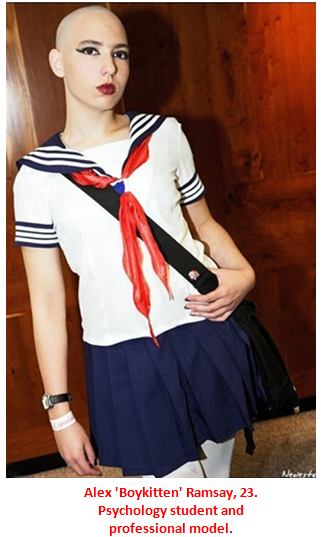
I decided to post a status on Facebook asking if anyone knew any transgender models that I would be able to get in touch with to try and attain an image to go with my piece. My efforts paid off and as it turned out that the girl who lives next door to me had a family friend, called Alex Ramsey, who is a transgender model. I contacted Ramsey and explained the situation. He was extremely helpful and gave me permission to pick a photograph off his website to use to go with my piece, as long as I included his name and profession.
He had hundreds of pictures, and I knew I wanted to find one where he looked as feminine as possible. I also needed to choose a photo that would be appropriate to appear with the article, as some of his images were quite risqué. In the end I chose an image of Ramsey dressed as a school girl, and even though he has no hair in the image, his make up, outfit and bone structure made him look like a woman:

Finding the background information about transgender modelling, and in particular Pejic and Lea T was not particularly difficult as they have both been featured heavily in the media and the fashion industry. The most difficult thing about this piece was trying to get permission to use pictures of either Pejic or T.
I got in contact with both of their agencies around the world, and the publications their images were featured in from Italian Vogue to The Daily Mail but had absolutely no luck. The best offer I had was that I would be given permission to use the image at the cost of $91 Australian Dollars for every day it was up on line. It became apparent that it was not going to be possible to get permission to use images of either model, and I needed to start thinking outside the box.
I decided to post a status on Facebook asking if anyone knew any transgender models that I would be able to get in touch with to try and attain an image to go with my piece. My efforts paid off and as it turned out that the girl who lives next door to me had a family friend, called Alex Ramsey, who is a transgender model. I contacted Ramsey and explained the situation. He was extremely helpful and gave me permission to pick a photograph off his website to use to go with my piece, as long as I included his name and profession.
He had hundreds of pictures, and I knew I wanted to find one where he looked as feminine as possible. I also needed to choose a photo that would be appropriate to appear with the article, as some of his images were quite risqué. In the end I chose an image of Ramsey dressed as a school girl, and even though he has no hair in the image, his make up, outfit and bone structure made him look like a woman:
Monday, 5 December 2011
Critical Reflection: Holiday Cheer, Henna and Happy Snapping
Normally I write my column pieces about ideas that come from experiences I have had during the week, but for this piece my experience from the week came from my idea for my column. This was the first time I have travelled to London specifically as a journalism student rather than just for fun. I have to admit that I was apprehensive about the day in London because, coming from Guernsey, I had concerns about getting lost of being mugged by everyone I met! After negotiating my way through the underground I arrived at Earl's Court and entered the show.
Initially I had thought that the best think to do would be to find the celebrities who were supposed to be at the show, because I thought that writing about the celebrities would be more interesting than just reading about my experience of going to the show. I managed to find Laurence Llewelyn Bowen and Gino D'Acampo and get pictures with them but neither of them had enough time for an interview which was disappointing. However I then decided that it would have been somewhat pointless to go the Christmas Ideal Home Show and then only write about the celebrities, because that would not really relate to the events of the day.
I then needed to think of another angle for my piece. I thought about what people go to the show for, and concluded that whilst some people are there to purchase items, the vast majority of people were there to look around at the stands but without actually purchasing anything. I wondered why this could be and then thought that one of the reasons could have been that people did not have the money to spend on 'luxury' items. I then thought about my audience, largely students, and that if they were at the show it would not be likely that they would be able to buy all the things that they wanted.
I then decided to base my angle around this idea. I decided to give myself a theoretical budget of £1000 for the day and would go around picking the things I would buy if my £1000 was real. This was actually much more difficult than I realised as the first thing I wanted to buy cost more than my total budget, and it became clear that I would need to choose more sensibly.
I thought that this would be a good angle for my piece because it would be something that my audience might be able to relate to; wanting to buy loads of things but not having a budget that allows for it.
When it came to writing my piece, my first draft was mainly about meeting Gino D'Acampo. However, this was not focusing on the angle of the piece and so I rewrote the entire piece writing towards my intended angle. I decided to include a little bit about D'Acampo because I thought that this would have been quite interesting to read alongside my imaginary shopping trip.
In the first draft of this piece I made a mistake by naming a well known supermarket but highlighted it as being a budget store in comparison to one that sells luxury items. Katie highlighted this mistake to me and explained that although I had included it as a well known reference to a budget store, it was still defamatory. I removed the name of the store from the piece, and have learnt that defaming a store is as serious as defaming an individual. There could have also been issues with accidentally defaming anyone who shopped in the store, which is something I had not considered when writing the piece.
I think that the biggest challenge with this piece was choosing an angle that would make the piece interesting before actually writing it. I think in future I need to make sure that I definitely have a chosen angle before I start writing, rather then start writing and thinking of an angle along the way.
Initially I had thought that the best think to do would be to find the celebrities who were supposed to be at the show, because I thought that writing about the celebrities would be more interesting than just reading about my experience of going to the show. I managed to find Laurence Llewelyn Bowen and Gino D'Acampo and get pictures with them but neither of them had enough time for an interview which was disappointing. However I then decided that it would have been somewhat pointless to go the Christmas Ideal Home Show and then only write about the celebrities, because that would not really relate to the events of the day.
I then needed to think of another angle for my piece. I thought about what people go to the show for, and concluded that whilst some people are there to purchase items, the vast majority of people were there to look around at the stands but without actually purchasing anything. I wondered why this could be and then thought that one of the reasons could have been that people did not have the money to spend on 'luxury' items. I then thought about my audience, largely students, and that if they were at the show it would not be likely that they would be able to buy all the things that they wanted.
I then decided to base my angle around this idea. I decided to give myself a theoretical budget of £1000 for the day and would go around picking the things I would buy if my £1000 was real. This was actually much more difficult than I realised as the first thing I wanted to buy cost more than my total budget, and it became clear that I would need to choose more sensibly.
I thought that this would be a good angle for my piece because it would be something that my audience might be able to relate to; wanting to buy loads of things but not having a budget that allows for it.
When it came to writing my piece, my first draft was mainly about meeting Gino D'Acampo. However, this was not focusing on the angle of the piece and so I rewrote the entire piece writing towards my intended angle. I decided to include a little bit about D'Acampo because I thought that this would have been quite interesting to read alongside my imaginary shopping trip.
In the first draft of this piece I made a mistake by naming a well known supermarket but highlighted it as being a budget store in comparison to one that sells luxury items. Katie highlighted this mistake to me and explained that although I had included it as a well known reference to a budget store, it was still defamatory. I removed the name of the store from the piece, and have learnt that defaming a store is as serious as defaming an individual. There could have also been issues with accidentally defaming anyone who shopped in the store, which is something I had not considered when writing the piece.
I think that the biggest challenge with this piece was choosing an angle that would make the piece interesting before actually writing it. I think in future I need to make sure that I definitely have a chosen angle before I start writing, rather then start writing and thinking of an angle along the way.
Tuesday, 22 November 2011
WINOL Critical Reflection: 16/11/11
Headlines: The headline clips this week once again looked professional. In particular, I thought that the clip from the football match was interesting and of a very high quality. The only criticism this week was that, in the clip of Caret, it would have been better if a clip without subtitles was used in the headlines because it was confusing to watch.
Unemployment: As Becky explained in the debrief, she was not given much warning at all to write a script for this piece which resulted in an overuse of statistics, however given more time this would probably not have been the case. I thought it was good how Gareth asked if the unemployment statistics could be broken down locally, because that is really what the audience would be most interested in. It would have been better to start with this question rather than the general statistics, although again I understand this was probably due to lack of time. When watching this I was slightly confused as to whether Becky had memorised the script, or whether she was only looking at the autocue extremely subtly. If she had memorised it then that is very impressive, but I thought that it looked a bit unprofessional to not be looking either at the camera or Gareth. It also gave the impression that she was not getting the information from anywhere other than her own memory which, as a consequence, made me unsure on how accurate the information was.
Unions: I thought that Lou's piece this week was very good, however I still think that he needs to slow down on his voice overs so that it is a bit easier to follow what he is saying. The interview with Royston Smith was a bit wonky but was otherwise well framed. The interview with Mike Tuckett would have been better if Tuckett had known where to look because he looked a bit shifty and like a deer caught in the headlights. However Lou said this was because he was a very difficult interviewee. Other than that, Lou framed the shot perfectly. I thought that once again this week Lou's piece to camera was an improvement since his first attempts earlier this year - he just needs to check his collar is straight!
Paedophile: I thought that the link to this piece was well written and professional, highlighting the seriousness of what would be coming next. I liked how Flick zoomed in on the photo of the convicted man because it looked to be more than a still image; she had clearly taken on board the suggestions about using still images from her piece on Antarctica a few weeks ago. I felt that the piece would have been stronger if Flick had had a more serious tone to her voice, however I understand how difficult the piece was and that this was the first time she had to cover such a serious piece. Flick did incredibly well to avoid any accidental deffamation or accidently breaking the anonymity of the victim. By showing the picture of the guilty man and naming him, Flick ensured that she positively indentified him so that no one with the same name could claim that she defamed them. Victims of sexual assult have anonymity for life, and as the man had been a neighbour of the victim, Flick made sure that she did not give the man's address because this could have revealed the identity of the victim.
Parking: I thought that Lee did well finding shots that were not boring for this story when all he really had to work with was a car park - and he was not allowed to film any license plates without the owner's permission. I thought that the interview with Alan Rickman was well framed and the sound quality was good. In the debrief Lee explained how he had managed to grab George Beckett in the street to get the interview. I thought that this was extremely professional, and even though it was not framed well well, you could hear what Beckett was saying and could see him clearly which is the most important thing. Brian suggested that a way to make this piece stonger would have been to film the carpark for 10 or 15 minutes as cars come in and out and then speed up the footage when editing it.
Mobile App: The piece about the university introducing a mobile app was brilliant to include as the majority of viewers are students at the univeristy so it was directly relevant to them. Unfortunately the video and sound quality in this piece were not good at all, although this could have been due to technical problems.
Football: As usual, the football news this weeek was very strong. However, as Brian explained, the main point of the piece should have been about how the hatrick was the fastest ever scored by a substitute (at least that is what I gathered the fact was!) because this would have been a genuinely interesting fact even to people who do not take an interest in football. The interviews in this piece were well framed and to a high standard. The promo for Sports Week in the bulliten was extremely confusing, it would have been better to show clips from the packages in Sports Week instead of showing the presenter.
Radio: The shot at the start of this piece was really good, and a definite step up for Tom. It was brave of him to think outside the box and do a close up shot, and it paid off! It was confusing in the piece to have the interview with Aarran Summers as a voice over instead of an actual shot of him which would have been more interesting to watch. The interview with Joyce Carter was good and well framed. The interview with Maxine was brilliant, really well framed and interesting, and Tom made sure she was looking the opposite way to Carter.
Presenter: This was the first time I had seen Gareth presenting and I thought he did really well, especially as he ensured he had a different tone for the news than for when he is presenting the sports.
Unemployment: As Becky explained in the debrief, she was not given much warning at all to write a script for this piece which resulted in an overuse of statistics, however given more time this would probably not have been the case. I thought it was good how Gareth asked if the unemployment statistics could be broken down locally, because that is really what the audience would be most interested in. It would have been better to start with this question rather than the general statistics, although again I understand this was probably due to lack of time. When watching this I was slightly confused as to whether Becky had memorised the script, or whether she was only looking at the autocue extremely subtly. If she had memorised it then that is very impressive, but I thought that it looked a bit unprofessional to not be looking either at the camera or Gareth. It also gave the impression that she was not getting the information from anywhere other than her own memory which, as a consequence, made me unsure on how accurate the information was.
Unions: I thought that Lou's piece this week was very good, however I still think that he needs to slow down on his voice overs so that it is a bit easier to follow what he is saying. The interview with Royston Smith was a bit wonky but was otherwise well framed. The interview with Mike Tuckett would have been better if Tuckett had known where to look because he looked a bit shifty and like a deer caught in the headlights. However Lou said this was because he was a very difficult interviewee. Other than that, Lou framed the shot perfectly. I thought that once again this week Lou's piece to camera was an improvement since his first attempts earlier this year - he just needs to check his collar is straight!
Paedophile: I thought that the link to this piece was well written and professional, highlighting the seriousness of what would be coming next. I liked how Flick zoomed in on the photo of the convicted man because it looked to be more than a still image; she had clearly taken on board the suggestions about using still images from her piece on Antarctica a few weeks ago. I felt that the piece would have been stronger if Flick had had a more serious tone to her voice, however I understand how difficult the piece was and that this was the first time she had to cover such a serious piece. Flick did incredibly well to avoid any accidental deffamation or accidently breaking the anonymity of the victim. By showing the picture of the guilty man and naming him, Flick ensured that she positively indentified him so that no one with the same name could claim that she defamed them. Victims of sexual assult have anonymity for life, and as the man had been a neighbour of the victim, Flick made sure that she did not give the man's address because this could have revealed the identity of the victim.
Parking: I thought that Lee did well finding shots that were not boring for this story when all he really had to work with was a car park - and he was not allowed to film any license plates without the owner's permission. I thought that the interview with Alan Rickman was well framed and the sound quality was good. In the debrief Lee explained how he had managed to grab George Beckett in the street to get the interview. I thought that this was extremely professional, and even though it was not framed well well, you could hear what Beckett was saying and could see him clearly which is the most important thing. Brian suggested that a way to make this piece stonger would have been to film the carpark for 10 or 15 minutes as cars come in and out and then speed up the footage when editing it.
Mobile App: The piece about the university introducing a mobile app was brilliant to include as the majority of viewers are students at the univeristy so it was directly relevant to them. Unfortunately the video and sound quality in this piece were not good at all, although this could have been due to technical problems.
Football: As usual, the football news this weeek was very strong. However, as Brian explained, the main point of the piece should have been about how the hatrick was the fastest ever scored by a substitute (at least that is what I gathered the fact was!) because this would have been a genuinely interesting fact even to people who do not take an interest in football. The interviews in this piece were well framed and to a high standard. The promo for Sports Week in the bulliten was extremely confusing, it would have been better to show clips from the packages in Sports Week instead of showing the presenter.
Radio: The shot at the start of this piece was really good, and a definite step up for Tom. It was brave of him to think outside the box and do a close up shot, and it paid off! It was confusing in the piece to have the interview with Aarran Summers as a voice over instead of an actual shot of him which would have been more interesting to watch. The interview with Joyce Carter was good and well framed. The interview with Maxine was brilliant, really well framed and interesting, and Tom made sure she was looking the opposite way to Carter.
Presenter: This was the first time I had seen Gareth presenting and I thought he did really well, especially as he ensured he had a different tone for the news than for when he is presenting the sports.
Sunday, 20 November 2011
Critical Reflection: Would you rather?
I had the idea for this piece because my mum sent me a poster listing the Dalai Lama's 'Instructions for Life'. I knew that I wanted to the piece to end with my suggestions of similar instructions, but ones written by a young person for a young person because this is not something that I have seen done before; most wisdom is passed from older generations to younger ones.
I was having difficulty trying to find an opening to piece because I didn't want to jump straight into questioning why wisdom is only passed down generations instead of up or horizontally!
When playing 'would you rather' with my friends, and someone posed the question 'would you rather skip 10 years into the future or 10 years back in the past?' I knew it would be the perfect way to lead into my column this week. I have to say I was surprised to find so many of my friends had regrets, and more suprised by the fact that when I actually stopped to think I realised I had regrets as well.
I did not want this piece to be comical because I did not feel comfortable trying to make light of the fact that people my age already have regrets about their relatively short lives to date. I decided to compose 10 'instructions' because I felt that 5 were not enough, but the 19 from the Dalai Lama were too many.
I created the instructions by thinking about the things I regret, or wish that I hadn't worried about so much, on the assumption that other young people worry about similar things. I did not want the instructions to be really deep and meaningful about life, in the way that an adult would, instead I wanted to make them simple and directly relatable to the lives of teenagers today.
I am really happy with the piece, particularly because it was a change of pace from my usual, sarcastic mocking columns.
I was having difficulty trying to find an opening to piece because I didn't want to jump straight into questioning why wisdom is only passed down generations instead of up or horizontally!
When playing 'would you rather' with my friends, and someone posed the question 'would you rather skip 10 years into the future or 10 years back in the past?' I knew it would be the perfect way to lead into my column this week. I have to say I was surprised to find so many of my friends had regrets, and more suprised by the fact that when I actually stopped to think I realised I had regrets as well.
I did not want this piece to be comical because I did not feel comfortable trying to make light of the fact that people my age already have regrets about their relatively short lives to date. I decided to compose 10 'instructions' because I felt that 5 were not enough, but the 19 from the Dalai Lama were too many.
I created the instructions by thinking about the things I regret, or wish that I hadn't worried about so much, on the assumption that other young people worry about similar things. I did not want the instructions to be really deep and meaningful about life, in the way that an adult would, instead I wanted to make them simple and directly relatable to the lives of teenagers today.
I am really happy with the piece, particularly because it was a change of pace from my usual, sarcastic mocking columns.
Friday, 18 November 2011
WINOL Critical Reflection 09/11/11
Headlines: I thought that the headlines this week were really strong. There was a good soundbite, a punchy script, and I like the natural sound on the graduate and fencing pieces.
Student Protests: I thought that it was really good that Tom had actually gone to London to report on the protests. His piece to camera was once again good and was easy to understand. He also made sure he only gave the facts, not any comments. I thought that the piece could have been stronger if he had interviewed one of the protesters, or had some footage of the protests rather than a piece to camera for the whole package. The sound quality could also have been improved, but you were able to hear him so it was not too bad!
Chris Huhne: I thought that the interview with Chris Huhne was well framed, and had a good sound quality. He did not give any of the facts, only comment, which is exactly what Chris and Brian have been stressing is essential to get right. I also thought that the footage from the debate was good because Julie managed to get a good soundbite of Huhne, and a close up shot which looked professional.
Housing: The shots that Lou had for this package were relevant and surprisingly varied given the availability of shots that would have been relevant to the piece. I thought that his voice over would have been better if he had talked a bit slower because I found it difficult to follow what he was saying. The interview with George Beckett was well framed, although it seemed as though the camera was looking down on him a little bit - but this may be a misconception on my part! I thought that the interview was a huge improvement from Lou's first interview where he was talking to the woman in the care home, because he had a close up even though Beckett was sitting down. The cut aways were confusing in this piece because they were shots of Beckett, while Beckett was being interviewed. It would have been better if Lou had been able to find a cut away of someone or something else.
I do not think that the interview with Patrick Davies was particularly well framed because he was central, the top of his head was out of shot, and the camera was too far away from him.
I thought that Lou's piece to camera was much better this week, and can tell he had made an effort to make sure he was looking up throughout it!
Occupy Bournemouth and Bin Updates: I thought it was good that updates were given to the viewer on both the occupy Bournemouth and bin collection stories. The shots for both updates were relevant and well framed.
Primary Schools: I really like the opening shot of this package. Over the shoulder shots have not really been used on WINOL so far this year, so it was a refreshing change. The shots around the classroom were a bit unsteady. The interview with Rory Perry was well framed and the sound quality was excellent. Lee did well in making sure that the second person he interviewed was facing the opposite was to Perry. I also liked how the final show was of a pound sign on the smart board, which was relevant to the story.
Sport: The Olympic Torch story was a refreshing change to the usual football updates. It was a story that would probably be of interest to people who do not particularly like sports because it is a momentous event happening in the local area. I really like the graphics showing the route of the Torch, I thought it looked really professional. However, Mikey needed to be stood slightly more to the left of the screen so that the viewer could see the entire map. There was a noticeable sound problem at the start of the piece, but this was resolved quickly.
The fencing piece was good, and again a nice change from the football. I am not sure if I liked the fact that Mikey introduced the package himself after talking about the Olympic Torch. I think it would have been better for Cara to introduce the piece. I liked the natural sound in the fencing piece, and you could still hear Mikey well. The interview with Jon Rhodes was well framed in the sense that he was not completely central in the shot. However I think it would have been better if he had not been looking so straight on to the camera. Normally I would suggest a tighter shot, but in this case I liked that you could see the Olympic badge Rhodes was wearing.
The football footage was once again of a very high standard this week.
Graduation: Flick got some really good shots of the graduates for this piece. I really like the angle she found about the identical twins with identical degrees, which added something more to the piece rather than just a normal graduation story. I liked the shot of the procession, including the Major because it was directly related to what Flick was talking about in the voice over. Like Lee, Flick made sure the second person she interviewed was looking the opposite way to the first one.
Presenting: I thought that George did a really excellent job of presenting WINOL for the first time. He looked professional, had a good pace to his voice and his hands did not look awkward! Well done George!
Student Protests: I thought that it was really good that Tom had actually gone to London to report on the protests. His piece to camera was once again good and was easy to understand. He also made sure he only gave the facts, not any comments. I thought that the piece could have been stronger if he had interviewed one of the protesters, or had some footage of the protests rather than a piece to camera for the whole package. The sound quality could also have been improved, but you were able to hear him so it was not too bad!
Chris Huhne: I thought that the interview with Chris Huhne was well framed, and had a good sound quality. He did not give any of the facts, only comment, which is exactly what Chris and Brian have been stressing is essential to get right. I also thought that the footage from the debate was good because Julie managed to get a good soundbite of Huhne, and a close up shot which looked professional.
Housing: The shots that Lou had for this package were relevant and surprisingly varied given the availability of shots that would have been relevant to the piece. I thought that his voice over would have been better if he had talked a bit slower because I found it difficult to follow what he was saying. The interview with George Beckett was well framed, although it seemed as though the camera was looking down on him a little bit - but this may be a misconception on my part! I thought that the interview was a huge improvement from Lou's first interview where he was talking to the woman in the care home, because he had a close up even though Beckett was sitting down. The cut aways were confusing in this piece because they were shots of Beckett, while Beckett was being interviewed. It would have been better if Lou had been able to find a cut away of someone or something else.
I do not think that the interview with Patrick Davies was particularly well framed because he was central, the top of his head was out of shot, and the camera was too far away from him.
I thought that Lou's piece to camera was much better this week, and can tell he had made an effort to make sure he was looking up throughout it!
Occupy Bournemouth and Bin Updates: I thought it was good that updates were given to the viewer on both the occupy Bournemouth and bin collection stories. The shots for both updates were relevant and well framed.
Primary Schools: I really like the opening shot of this package. Over the shoulder shots have not really been used on WINOL so far this year, so it was a refreshing change. The shots around the classroom were a bit unsteady. The interview with Rory Perry was well framed and the sound quality was excellent. Lee did well in making sure that the second person he interviewed was facing the opposite was to Perry. I also liked how the final show was of a pound sign on the smart board, which was relevant to the story.
Sport: The Olympic Torch story was a refreshing change to the usual football updates. It was a story that would probably be of interest to people who do not particularly like sports because it is a momentous event happening in the local area. I really like the graphics showing the route of the Torch, I thought it looked really professional. However, Mikey needed to be stood slightly more to the left of the screen so that the viewer could see the entire map. There was a noticeable sound problem at the start of the piece, but this was resolved quickly.
The fencing piece was good, and again a nice change from the football. I am not sure if I liked the fact that Mikey introduced the package himself after talking about the Olympic Torch. I think it would have been better for Cara to introduce the piece. I liked the natural sound in the fencing piece, and you could still hear Mikey well. The interview with Jon Rhodes was well framed in the sense that he was not completely central in the shot. However I think it would have been better if he had not been looking so straight on to the camera. Normally I would suggest a tighter shot, but in this case I liked that you could see the Olympic badge Rhodes was wearing.
The football footage was once again of a very high standard this week.
Graduation: Flick got some really good shots of the graduates for this piece. I really like the angle she found about the identical twins with identical degrees, which added something more to the piece rather than just a normal graduation story. I liked the shot of the procession, including the Major because it was directly related to what Flick was talking about in the voice over. Like Lee, Flick made sure the second person she interviewed was looking the opposite way to the first one.
Presenting: I thought that George did a really excellent job of presenting WINOL for the first time. He looked professional, had a good pace to his voice and his hands did not look awkward! Well done George!
Critical Reflection: Confused and Concerned
Initially my idea for this column had been to go to the torchlight procession and write about better uses of money than fireworks, or about the stereotypically members of the public who attend events such as this. However as soon as I saw the torches being handed out and being given to children I decided that it would be better to change the angle of my column.
The issue of health and safety is something that is often in the media, but more often than not policies draw media attention because they are overly cautions. I thought that writing about the total absence of health and safety would make my piece more interesting because it would be different to what the reader would expect.
I wanted to include some ridiculous health and safety rules with the piece to act as a contrast to the violations I had seen at the event. At first I included the examples in this way:
The issue of health and safety is something that is often in the media, but more often than not policies draw media attention because they are overly cautions. I thought that writing about the total absence of health and safety would make my piece more interesting because it would be different to what the reader would expect.
I wanted to include some ridiculous health and safety rules with the piece to act as a contrast to the violations I had seen at the event. At first I included the examples in this way:
It seems absurd to me that in a world where children are not allowed to play conkers without safety goggles, take a pencil case into the classroom or use floatation devices, that they were being allowed to hold flaming torches.
I was not happy with the way I had done this because I felt that what I had written was too lengthy and did not read as dramatically or humorously as it could do. For this reason, I decided to start the piece with the extreme health and safety rules. I did this so that the reader would expect the column to be another piece about how out of control health and safety rules have become, and would then be surprised to find it is actually about the lack of health and safety.
I chose to state the health and safety rules in a FAQ style. I did this because I thought it would be more interested to read than a block of text stating the rules. The first three questions should make the reader expect the answers to be yes, and the fact that the answers are no would make the reader assume that the answer to the last question would definitely be no.
I thought it would be a good idea to include the fact that, even at 19, I found the torches difficult and dangerous to carry to give a sense of how dangerous it would be for a child to be holding one. I described the children as 'weaving through the crowds, in a hyped up, squealing frenzy holding what one child described as a "fire gun"' to highlight the chaos of the situation, which added to the danger. I decided to include one child's description of the torch as a 'fire gun' to make the point that the children were aware of how dangerous what they were carrying were, and that, at least that one child, was intending to use it as a weapon in his game.
When describing the father who had his child up on his shoulders, I made the comparison of the child's jacket to making him look like 'the Michelin Man'. I thought that this would be a comical comparison, as most readers will recognise the image of the Michelin Man, and would then be able to picture the jacket I was describing even if they had never seen a child in one before.
I ended the piece by describing my genuine confusion between whether it would have been better to health and safety regulations in that situation, or whether it was better to let people have one night where they could be careless. I did this partly to share my feelings about the whole night and partly to get the reader to think about whether it is better to try and prevent accidents or to just live carelessly and deal with accidents if they occur.
Critical Reflection: Gratuitously Convoluted Language
So far this is the column which has taken the most research. I downloaded and read over 50 UK university prospectuses to find the best examples of unnecessarily over complicated language. I also sent for prospetuses through the post so that I would be able to photograph the covers to use as an image to go with the column.
In my first draft I named the universities I had found the quotes from. After talking it through with Katie, the features editor, she suggested that it would be best to leave out the university names because the comments could be seen as defamatory. So I changed the piece to be more generalised about UK universities in order to avoid this problem. I also made sure that when I took the photographs of the prospectus covers that the name of the universities were not visible.
I tried to make this piece as comical as possible because I think would be something that the readers could relate to. This is because the audience for the WINOL features site is largely current, past or prospective university students, presumably all of whom will have read prospectuses which choosing a university. I had written a different column for this week but, as Katie pointed out, it made more sense to use this one first because it ties in with university open days and students making university applications.
I have found that I am starting to create a style for my column, largely social commentary which I attempt to make comical when appropriate. Katie's feedback on my pieces has been invaluable, and has helped shaped my written style.
In my first draft I named the universities I had found the quotes from. After talking it through with Katie, the features editor, she suggested that it would be best to leave out the university names because the comments could be seen as defamatory. So I changed the piece to be more generalised about UK universities in order to avoid this problem. I also made sure that when I took the photographs of the prospectus covers that the name of the universities were not visible.
I tried to make this piece as comical as possible because I think would be something that the readers could relate to. This is because the audience for the WINOL features site is largely current, past or prospective university students, presumably all of whom will have read prospectuses which choosing a university. I had written a different column for this week but, as Katie pointed out, it made more sense to use this one first because it ties in with university open days and students making university applications.
I have found that I am starting to create a style for my column, largely social commentary which I attempt to make comical when appropriate. Katie's feedback on my pieces has been invaluable, and has helped shaped my written style.
Friday, 11 November 2011
WINOL Critical Reflection - 02/11/11
Overall I think that the bulletin this week was the best so far in terms of quality and professionalism. Here are my thoughts about it in detail...
Headlines: I thought that the headlines this week were excellent. There were good soundbites, and interesting, top quality video clips. The only criticism would be that it might be better if the strap lines were a bit bigger to make them clearer and easier for the viewer to read, although this is not a major problem because it is possible to read them at the the size they were.
Brine interview: I thought the interview with Steve Brine was excellent. It was really well framed, you could hear him clearly, and the background was relevant but did not take any attention away from Brine. In addition to this, he gave some good sound bites, and the whole interview stuck to the rule that comment should be in the interviewee's voice and facts should be in the interviewers voice. I don't have anything to criticise about it at all.
Farage interview: I thought that the interview with Farage was not as good as the Brine interview. Although you could hear what he was saying, the sound was not top quality, it was a bit fuzzy.He seemed to be in quite a dark area, although I understand that this was possibly unavoidable. I think it would have looked better if Farage had been decentred in the shot, and if it was just a bit tighter so we could see more of his face.
Occupy Bournemouth: This piece was good because Ali made sure that the facts were in his voice, and all the comment was given by the people he was interviewing. Initially the shots in the piece were good and relevant, such as the tents, and people painting signs, although the 99% sign was quite confusing. However there were quite a few shots of a sign with very small writing, which was impossible for the viewer to read. I might have been better if Ali had found a clearer sign to film. The interview in the tent was well framed, and it was good that the two people Ali interviewed were facing different ways. Overall I thought he got some good sound bites and relevant interviews. I also thought it was good that WINOL went back to Ali for an update, so that the viewer knew that they had the most up to date information on the situation.
Bin Collection: I thought that the shots at the start of this piece were really good, they were clear and completely relevant. Like Ali, Lee also made sure that the facts were in his voice, and the comments came from people he was interviewing. I thought it was an improvement on Lee's last piece because he took on board the comments and using complicated figures, and this time the figures he gave were simplified. He made sure that the piece was balanced, which was professional. I thought his sign off was, again, professional, but could have been better if the shot was a bit tighter because the background was distracting.
Sport: I thought the sport handover was good again this week. However, David said that Dael 'had the pleasure of being at the game.' This was purely comment and so was unnecessary. The sport, as usual, was of a very high standard and the commentary was professional. As Brian stated in the debrief 'less is more', and I would agree that the football piece in particular was much too long. I also agree with the comments from the first years, that there needs to be some mention of what story is coming up after the sport so that viewers who are not interested in sport do not lose interest. Perhaps there could be a "coming up next" rolling along the bottom of the screen while the sport is on.
Lasers: I really liked the start of Tom's piece about laser technology, the close up of the 'danger' sign then the zoom out to reveal the lab. I thought this was good because the danger sign would grab the attention of the viewer who would want to find out what the dangerous thing is. Tom did well to keep the facts in voice throughout the piece without adding comment. I think that Tom took on board comments about his pieces to camera needing to be shorter, which he did successfully this week. The interview with Rob Eason was relevant and you could hear him clearly, but I felt that he needed to be looking more face on at the camera.
WINOL Life: I like the addition of the clips from WINOL Life as the 'and finally' piece this week.
Headlines: I thought that the headlines this week were excellent. There were good soundbites, and interesting, top quality video clips. The only criticism would be that it might be better if the strap lines were a bit bigger to make them clearer and easier for the viewer to read, although this is not a major problem because it is possible to read them at the the size they were.
Brine interview: I thought the interview with Steve Brine was excellent. It was really well framed, you could hear him clearly, and the background was relevant but did not take any attention away from Brine. In addition to this, he gave some good sound bites, and the whole interview stuck to the rule that comment should be in the interviewee's voice and facts should be in the interviewers voice. I don't have anything to criticise about it at all.
Farage interview: I thought that the interview with Farage was not as good as the Brine interview. Although you could hear what he was saying, the sound was not top quality, it was a bit fuzzy.He seemed to be in quite a dark area, although I understand that this was possibly unavoidable. I think it would have looked better if Farage had been decentred in the shot, and if it was just a bit tighter so we could see more of his face.
Occupy Bournemouth: This piece was good because Ali made sure that the facts were in his voice, and all the comment was given by the people he was interviewing. Initially the shots in the piece were good and relevant, such as the tents, and people painting signs, although the 99% sign was quite confusing. However there were quite a few shots of a sign with very small writing, which was impossible for the viewer to read. I might have been better if Ali had found a clearer sign to film. The interview in the tent was well framed, and it was good that the two people Ali interviewed were facing different ways. Overall I thought he got some good sound bites and relevant interviews. I also thought it was good that WINOL went back to Ali for an update, so that the viewer knew that they had the most up to date information on the situation.
Bin Collection: I thought that the shots at the start of this piece were really good, they were clear and completely relevant. Like Ali, Lee also made sure that the facts were in his voice, and the comments came from people he was interviewing. I thought it was an improvement on Lee's last piece because he took on board the comments and using complicated figures, and this time the figures he gave were simplified. He made sure that the piece was balanced, which was professional. I thought his sign off was, again, professional, but could have been better if the shot was a bit tighter because the background was distracting.
Sport: I thought the sport handover was good again this week. However, David said that Dael 'had the pleasure of being at the game.' This was purely comment and so was unnecessary. The sport, as usual, was of a very high standard and the commentary was professional. As Brian stated in the debrief 'less is more', and I would agree that the football piece in particular was much too long. I also agree with the comments from the first years, that there needs to be some mention of what story is coming up after the sport so that viewers who are not interested in sport do not lose interest. Perhaps there could be a "coming up next" rolling along the bottom of the screen while the sport is on.
Lasers: I really liked the start of Tom's piece about laser technology, the close up of the 'danger' sign then the zoom out to reveal the lab. I thought this was good because the danger sign would grab the attention of the viewer who would want to find out what the dangerous thing is. Tom did well to keep the facts in voice throughout the piece without adding comment. I think that Tom took on board comments about his pieces to camera needing to be shorter, which he did successfully this week. The interview with Rob Eason was relevant and you could hear him clearly, but I felt that he needed to be looking more face on at the camera.
WINOL Life: I like the addition of the clips from WINOL Life as the 'and finally' piece this week.
Thursday, 3 November 2011
Critical Refection: Bins, Black Bags and Bitching
My column this week was about an experience of living of halls. I thought that this would be an appropriate experience to write about because the majority of people who read this blog and who would be reading Diary of a Winchester Lady are university students, and so would probably be able to relate to the story.
At first I was concerned that writing the piece would be disrespectful to the girl involved in the argument, however as my column is purely social commentary of my experiences, I decided that there was no reason not to include this experience. I also chose this topic because I thought that I would be able to make it humorous.
I chose the title Bins, Black Bags and Bitching because the repetition of the explosive consonant 'B' creates a harsh sound when being read, which prepares the reader for the conflict in the piece. I also wanted to use a list of three because it is a commonly used literary devise.
I started the piece described how I was 'waiting silently...ready to pounce.' I thought that this would work well because I tried to make it sound as if I was a predator stalking my prey, and that this would get the attention of the reader who would then want to know what/who I was waiting for.
I wanted my description of the girl to fit with the theme of predator/prey. To do this I used words such as 'elegant' and 'easily startled'. I described how she 'scrambled to find her keys.' The use of the word 'scrambled' has connotations of panic and added to the intensity of the situation. I did not immediately reveal to the reader what I had been waiting for her for because I wanted to keep their attention so that they would want to read on to find out what the problem was. The statement 'she knew exactly what I wanted' makes the reader question whether they, too, will actually learn what I wanted.
I decided to include a flashback in this piece as a stalling mechanism before revealing what the reader wants to know. The flashback I chose is one which was relevant to the piece because it was about being polite to people when you really want to be rude. I decided to use this because I thought it was something that the reader would be able to relate to.
When I came to actually explaining what the issue had been I decided that I did not want to go into too much detail because this would be boring to read, and would be somewhat of an anticlimax to the piece! I decided to mention my annoyance at the misuse of the apostrophe because I thought that it would be something that the reader would be bound to have an opinion on, whether it annoyed them too, or whether they are someone who is annoyed by the apostrophe rules.
Ultimately I was pleased with the piece and hope was pleased to write something more light hearted and humorous in contrast to the seriousness of my column last week.
At first I was concerned that writing the piece would be disrespectful to the girl involved in the argument, however as my column is purely social commentary of my experiences, I decided that there was no reason not to include this experience. I also chose this topic because I thought that I would be able to make it humorous.
I chose the title Bins, Black Bags and Bitching because the repetition of the explosive consonant 'B' creates a harsh sound when being read, which prepares the reader for the conflict in the piece. I also wanted to use a list of three because it is a commonly used literary devise.
I started the piece described how I was 'waiting silently...ready to pounce.' I thought that this would work well because I tried to make it sound as if I was a predator stalking my prey, and that this would get the attention of the reader who would then want to know what/who I was waiting for.
I wanted my description of the girl to fit with the theme of predator/prey. To do this I used words such as 'elegant' and 'easily startled'. I described how she 'scrambled to find her keys.' The use of the word 'scrambled' has connotations of panic and added to the intensity of the situation. I did not immediately reveal to the reader what I had been waiting for her for because I wanted to keep their attention so that they would want to read on to find out what the problem was. The statement 'she knew exactly what I wanted' makes the reader question whether they, too, will actually learn what I wanted.
I decided to include a flashback in this piece as a stalling mechanism before revealing what the reader wants to know. The flashback I chose is one which was relevant to the piece because it was about being polite to people when you really want to be rude. I decided to use this because I thought it was something that the reader would be able to relate to.
When I came to actually explaining what the issue had been I decided that I did not want to go into too much detail because this would be boring to read, and would be somewhat of an anticlimax to the piece! I decided to mention my annoyance at the misuse of the apostrophe because I thought that it would be something that the reader would be bound to have an opinion on, whether it annoyed them too, or whether they are someone who is annoyed by the apostrophe rules.
Ultimately I was pleased with the piece and hope was pleased to write something more light hearted and humorous in contrast to the seriousness of my column last week.
Monday, 31 October 2011
WINOL Critical Reflection - 26/10/11
This week I helped with the production of WINOL by operating the auto-cue. It was really interesting to see how the bulletin is put together, although it was every bit as stressful as I had imagined it would be! Here are my thoughts on this week's bulletin:
Headlines: Once again I thought the headlines this week were done really well. I thought the best part about the headlines this week was that there was a good quote about the government spending that would have engaged the audience and made them want to find out what the government are spending money on. I thought the zoom out of the rugby posts were also good because it made it more interesting to watch than if it had just been an image of the pitch.
University Applications: I thought it was good that the bulletin started with the story about the drop in university applications because the majority of WINOL viewers are students at the university, so it was important that the main story was one which was going to be of interest to them. I thought the use of graphics in this piece was good, although it might have been better if there had been numbers on the graph about the number of applicants because that would have put it into perspective. Lou did well presenting this piece, although he was still looking down a bit it was a huge improvement from his first piece to camera.
Unemployment: I thought Lee's piece on unemployment was good and the graphics made it look more professional. However, the continual list of figures became confusing after a while so perhaps they could have been rounded or not as many used. The interview with Cllr Brain Dash was relevant and well framed, and you could hear him clearly. I liked Lee's use of the notebook when he was reading out the statement because it kept his hands doing something and also looked professional.
Pubs & Clubs: There were relevant shots in this piece with pubs and clubs around Winchester that would be recognisable to local audiences.
Sport: The story about the rugby pitch restoration was a good story but the footage could have been improved. The shots of the empty rugby pitch before showing a match seemed unnecessary. There was also a technical error when the interview started which meant that the strap line flashed up for only a second, making it impossible to read, and therefore it was confusing to watch the interview not knowing who was talking. It was also confusing when there was a voice over reading the statement. The voice was clearly not Henry's, but we were not told who it actually was. The interview with Tim Fell was well framed and relevant and you could clearly hear him. It might have been a bit better if it was more of a close up though. Despite the criticism, I thought that Henry's pieces to camera were extremely good and he looked really smart and authoritative.
I thought that the ice hockey shots were better this week because they were a lot shorter so were easy to follow. I also like the natural sound as well as Amy's voice over.
Once again the football reporting this week was excellent with clear commentary and shots of the goals from both the stands and behind the goals.
Zombosium: The interview with Marcus Leary was framed well and the sound was good, but he was only explaining that students will be studying Zombies, which had already been established. It would have been better to have his opinions about it instead of a repetition of the facts. Tom's use of fair dealing meant that he could show clips from Dawn of the Dead. He was able to use the clips because he made sure that there was a voice over at all times and only showed a few seconds. I thought that Tom's piece to camera was very good again.
Games Review: I thought that this extra feature was a great way to finish up the bulletin. It was short enough so that the viewers did not lose interest, and also showed clips of the games to keep audience attention. I thought that Ewan and Graham were excellent at presenting this piece because they seemed genuinely enthusiastic about the games.
Presenter: I thought that Justina did a really good job at presenting and looked the part. I thought she did particularly well given that English is not her first language.
Headlines: Once again I thought the headlines this week were done really well. I thought the best part about the headlines this week was that there was a good quote about the government spending that would have engaged the audience and made them want to find out what the government are spending money on. I thought the zoom out of the rugby posts were also good because it made it more interesting to watch than if it had just been an image of the pitch.
University Applications: I thought it was good that the bulletin started with the story about the drop in university applications because the majority of WINOL viewers are students at the university, so it was important that the main story was one which was going to be of interest to them. I thought the use of graphics in this piece was good, although it might have been better if there had been numbers on the graph about the number of applicants because that would have put it into perspective. Lou did well presenting this piece, although he was still looking down a bit it was a huge improvement from his first piece to camera.
Unemployment: I thought Lee's piece on unemployment was good and the graphics made it look more professional. However, the continual list of figures became confusing after a while so perhaps they could have been rounded or not as many used. The interview with Cllr Brain Dash was relevant and well framed, and you could hear him clearly. I liked Lee's use of the notebook when he was reading out the statement because it kept his hands doing something and also looked professional.
Pubs & Clubs: There were relevant shots in this piece with pubs and clubs around Winchester that would be recognisable to local audiences.
Sport: The story about the rugby pitch restoration was a good story but the footage could have been improved. The shots of the empty rugby pitch before showing a match seemed unnecessary. There was also a technical error when the interview started which meant that the strap line flashed up for only a second, making it impossible to read, and therefore it was confusing to watch the interview not knowing who was talking. It was also confusing when there was a voice over reading the statement. The voice was clearly not Henry's, but we were not told who it actually was. The interview with Tim Fell was well framed and relevant and you could clearly hear him. It might have been a bit better if it was more of a close up though. Despite the criticism, I thought that Henry's pieces to camera were extremely good and he looked really smart and authoritative.
I thought that the ice hockey shots were better this week because they were a lot shorter so were easy to follow. I also like the natural sound as well as Amy's voice over.
Once again the football reporting this week was excellent with clear commentary and shots of the goals from both the stands and behind the goals.
Zombosium: The interview with Marcus Leary was framed well and the sound was good, but he was only explaining that students will be studying Zombies, which had already been established. It would have been better to have his opinions about it instead of a repetition of the facts. Tom's use of fair dealing meant that he could show clips from Dawn of the Dead. He was able to use the clips because he made sure that there was a voice over at all times and only showed a few seconds. I thought that Tom's piece to camera was very good again.
Games Review: I thought that this extra feature was a great way to finish up the bulletin. It was short enough so that the viewers did not lose interest, and also showed clips of the games to keep audience attention. I thought that Ewan and Graham were excellent at presenting this piece because they seemed genuinely enthusiastic about the games.
Presenter: I thought that Justina did a really good job at presenting and looked the part. I thought she did particularly well given that English is not her first language.
WINOL Critical Reflection - 19/10/11
I was not involved in the production of WINOL this week so will once again be critiquing it purely as a viewer.
Headlines: I thought that it was really good that even though the picture of the man in handcuffs was a still image, because there was a zoom in it seemed to be more interesting, as though it was footage. I thought the zoom out on Princess Anne unveiling the plaque looked very professional and allowed you to see her clearly as well as then being able to see the main event of the unveiling. I also thought it was good that you could then hear the natural sound of applause and flashing cameras.
Police Exclusive: I thought it was brilliant that WINOL had an exclusive story, especially one which would be of great interest to Hampshire residents, not only students at the university. The graphics used while Julie was giving the story looked extremely professional, and were easy for the viewer to read. I really like the way that the offences stayed listed on the screen because it allowed the viewer to see the whole picture by the end of the story, when otherwise they may have forgotten some of the information. I also thought it was good that Julie very clearly presented the response of the Hampshire Police Force, because it meant that the story was balanced.
Energy Bills: I thought that the start of this package looked really professional in the way that it was unclear what we are looking at until the camera zooms out to reveal a gas hob. This was also good because it gets the viewers attention as they want to know what they are actually looking at. The interview with Jenny Meadows was completely relevant and was well framed. All the cut aways were also completely relevant to the story. Throughout the package Tom's voice over was extremely clear and well scripted. I thought this was a really professional piece.
Princess Anne: This package was quite good, although the quality of sound throughout could have been improved. Ali got some very good shots of Princess Anne which looked professional. In his voice over, Ali mentions Councillor Raymond, although there are no strap lines in this piece so it is not clear to the viewer as to whether the woman giving the speech before the unveiling is Councillor Raymond or not. Also, it could have been more of a close up of the woman to look more professional.
Strikes: I thought it was good that the story about the strikes in Southampton from last week were followed up this week. Although the same footage was used, this acted as more of a reminder of last week's story instead of a repetition.
Housing: Most of the shots about the piece on housing were relevant to the story, however the image of people's feet as they crossed the road were clearly those of school children. This was a bit confusing because the story was not directly involving school children other than the fact that they presumably live in houses. The interview with Cllr Ian Tait was relevant and well framed.
Speed Limit: The shots about the speed limit story were all well framed, in focus and relevant to the story. The only problem was that there was a jump in the footage from those shots to Amy in the studio.
Sport: I thought that Dale's commentary of the football was really good and sounded professional. I also thought it was good that there were shots from behind the goal as well as of the whole pitch because it added variation to the package. The interview with Sam Wilson was good but needed to be de-centered.
I thought the interview with Henry Olonga was good however the problems with the audio meant that you could not really hear what he was saying or why he was being interviewed.
The footage of the ice hockey was good again this week, especially because with such a fast moving game it would have been easy to miss the shots of the goals. I also thought that the footage of the two fights between the players was good because it added variation to watching goal after goal. However, similarly to last week I felt that this piece went on too long and became confusing to follow.
Rhinos: I thought that Flick's piece about the Rhinos was really good, especially the fact that she was actually able to film them rather than just using still images or not showing them at all. When she was stroking the Rhino she did look slightly terrified, although I would not say this was a criticism because I would not have wanted to do it!
Presenting: I thought that Amy did a really good job of presenting this week, and also noticed that her hair was off her face throughout the bulliten which looked professional.
Headlines: I thought that it was really good that even though the picture of the man in handcuffs was a still image, because there was a zoom in it seemed to be more interesting, as though it was footage. I thought the zoom out on Princess Anne unveiling the plaque looked very professional and allowed you to see her clearly as well as then being able to see the main event of the unveiling. I also thought it was good that you could then hear the natural sound of applause and flashing cameras.
Police Exclusive: I thought it was brilliant that WINOL had an exclusive story, especially one which would be of great interest to Hampshire residents, not only students at the university. The graphics used while Julie was giving the story looked extremely professional, and were easy for the viewer to read. I really like the way that the offences stayed listed on the screen because it allowed the viewer to see the whole picture by the end of the story, when otherwise they may have forgotten some of the information. I also thought it was good that Julie very clearly presented the response of the Hampshire Police Force, because it meant that the story was balanced.
Energy Bills: I thought that the start of this package looked really professional in the way that it was unclear what we are looking at until the camera zooms out to reveal a gas hob. This was also good because it gets the viewers attention as they want to know what they are actually looking at. The interview with Jenny Meadows was completely relevant and was well framed. All the cut aways were also completely relevant to the story. Throughout the package Tom's voice over was extremely clear and well scripted. I thought this was a really professional piece.
Princess Anne: This package was quite good, although the quality of sound throughout could have been improved. Ali got some very good shots of Princess Anne which looked professional. In his voice over, Ali mentions Councillor Raymond, although there are no strap lines in this piece so it is not clear to the viewer as to whether the woman giving the speech before the unveiling is Councillor Raymond or not. Also, it could have been more of a close up of the woman to look more professional.
Strikes: I thought it was good that the story about the strikes in Southampton from last week were followed up this week. Although the same footage was used, this acted as more of a reminder of last week's story instead of a repetition.
Housing: Most of the shots about the piece on housing were relevant to the story, however the image of people's feet as they crossed the road were clearly those of school children. This was a bit confusing because the story was not directly involving school children other than the fact that they presumably live in houses. The interview with Cllr Ian Tait was relevant and well framed.
Speed Limit: The shots about the speed limit story were all well framed, in focus and relevant to the story. The only problem was that there was a jump in the footage from those shots to Amy in the studio.
Sport: I thought that Dale's commentary of the football was really good and sounded professional. I also thought it was good that there were shots from behind the goal as well as of the whole pitch because it added variation to the package. The interview with Sam Wilson was good but needed to be de-centered.
I thought the interview with Henry Olonga was good however the problems with the audio meant that you could not really hear what he was saying or why he was being interviewed.
The footage of the ice hockey was good again this week, especially because with such a fast moving game it would have been easy to miss the shots of the goals. I also thought that the footage of the two fights between the players was good because it added variation to watching goal after goal. However, similarly to last week I felt that this piece went on too long and became confusing to follow.
Rhinos: I thought that Flick's piece about the Rhinos was really good, especially the fact that she was actually able to film them rather than just using still images or not showing them at all. When she was stroking the Rhino she did look slightly terrified, although I would not say this was a criticism because I would not have wanted to do it!
Presenting: I thought that Amy did a really good job of presenting this week, and also noticed that her hair was off her face throughout the bulliten which looked professional.
Subscribe to:
Posts (Atom)